
Industrial cleaning is not as simple as it sounds. Many businesses struggle with stubborn deposits, rust, grease, and scaling that regular cleaning methods cannot remove. Inefficient cleaning leads to downtime, higher maintenance costs, and reduced equipment life. According to industry reports, high pressure water cleaning is one of the most effective non-chemical cleaning methods used globally. This is where a water blasting pump becomes essential, offering powerful and precise cleaning for demanding industrial environments.
What is Water Blasting Pump?
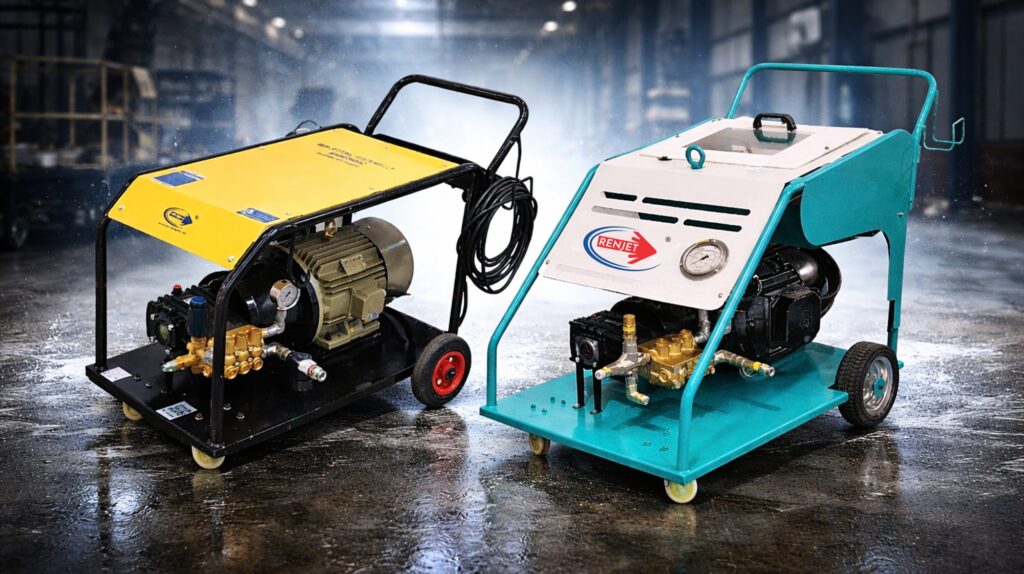
A water blasting pump is a high-pressure pump designed to force water at extremely high speeds to remove dirt, coatings, rust, or debris from surfaces. It is widely used in industrial cleaning where traditional methods fail. The pump converts mechanical energy into high-pressure water flow, enabling deep cleaning without chemicals. These systems are commonly used in heavy industries where precision and efficiency are critical for maintaining equipment and infrastructure.
Working of High Pressure Water Pump For Cleaning
A high pressure water pump for cleaning works by converting motor power into pressurized water flow. The process is simple yet highly effective.
Here is how it works:
- The motor drives the crankshaft inside the pump
- The crankshaft converts rotation into reciprocating motion
- Plungers move back and forth inside cylinders
- Water enters through inlet valves during suction
- Pressurized water exits through discharge valves
This process creates a consistent and powerful water stream used for cleaning, cutting, or surface preparation.
If your operations require reliable cleaning systems, choosing a well-engineered solution from Renjet can help improve efficiency and reduce downtime.
Common Types of Water Blasting Pumps
Choosing the right configuration depends on the intensity of the task and the desired portability. There are several types of water blasting pumps available in the market, each suited for different scales of operation. Renjet offers various models that utilize these different pump head designs to provide maximum durability for long shifts.
- Triplex Plunger Pumps
These are the most common variety, featuring three plungers that operate in a staggered sequence to provide a smooth, pulse-free flow of water. They are highly efficient for general industrial washing and paint stripping tasks.
- Consistent pressure output.
- Easy to maintain and repair.
- Suitable for most mobile cleaning units.
- Quintuplex Pumps
Equipped with five plungers, these units are designed for massive flow rates and even smoother operation than triplex models. They are typically found in large, stationary plant installations where high-volume cleaning is a constant requirement.
- Reduced vibration during high-speed runs.
- Capable of handling much larger volumes of water.
- Longer lifespan for internal components due to balanced load.
- Intensifier Pumps
Unlike standard plunger designs, these use hydraulic oil to push a large piston, which then drives a smaller water piston to create ultra-high pressures. These are often utilized in precision cutting or specialized coating removal applications.
- Can reach extremely high pressure levels.
- Ideal for stationary, controlled environments.
- Often used for water-jet cutting tables.
Essential Water Blasting Pump Applications in Industry
The versatility of this technology allows it to be used across multiple sectors for varied maintenance tasks. Understanding the specific water jet pump applications can help a facility determine if they should invest in their own dedicated unit.
- Surface Preparation: Removes rust, mill scale, and old coatings from metal structures before they are repainted to ensure better adhesion.
- Heat Exchanger Cleaning: Clears the internal tubes of boilers and condensers to restore proper thermal efficiency and prevent equipment overheating.
- Sewer and Drain Jetting: Uses high-velocity water to break up grease blockages and root intrusions in municipal or industrial piping systems.
- Tank and Vessel Scrubbing: Cleans the interior of large storage tanks used for oil or chemicals without requiring dangerous manual entry.
- Concrete Hydro-Demolition: Precisely removes layers of old concrete from bridges or dams without causing micro-fractures in the surrounding healthy structure.
Comparison of Industrial Pump Models
The following table compares different pump configurations commonly used in the industry to help you identify the right fit for your specific cleaning or blasting requirements.
| Pump Model | Pressure (Bar) | Flow Rate (LPM) | Best For |
|---|---|---|---|
| CW 150 (Single Phase) | 150 Bar | 8.5 LPM | Light workshop & vehicle cleaning |
| RJ NPM 15.25 | 250 Bar | 15 LPM | General surface & floor preparation |
| RJ PX 17.35 (Renjet) | 350 Bar | 17 LPM | Industrial pipe & small tank cleaning |
| RJ PX 21.50 | 500 Bar | 21 LPM | Heat exchanger & boiler tube cleaning |
| Ultra High Jet | 1000 Bar | 15-40 LPM | Hydro-demolition & coating removal |
Conclusion
High pressure cleaning has become an essential part of industrial maintenance, and choosing the right equipment plays a crucial role in achieving effective results. A water blasting pump provides powerful cleaning capability that helps remove stubborn deposits, improve equipment life, and maintain operational efficiency.
From understanding how these systems work to selecting the right type and application, businesses can benefit from investing in reliable solutions. With advanced systems offered by brands like Renjet, industries can ensure consistent performance, reduced downtime, and long-term cost efficiency in their cleaning operations.